Other Icons For Group Configuration

After studying our first efforts to define a "didactic process map language" Main.VincentTscherter proposed to emphasize the group configarion more by using other icons for the actors. He had the …


After studying our first efforts to define a "didactic process map language" Main.VincentTscherter proposed to emphasize the group configarion more by using other icons for the actors. He had the jigsaw method in mind and drawed something like this on the whiteboard:
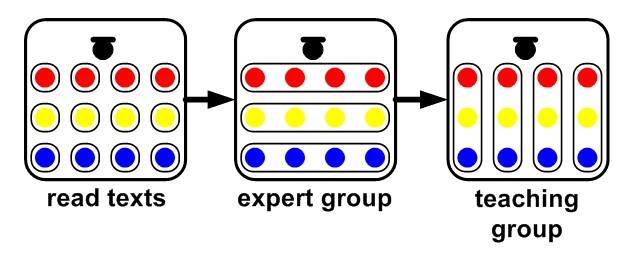
jigsaw-vincent-tschert-visualization.jpg

So instead of these icons

actors1.jpg

I first used a class size of 16 as Vincent proposed:
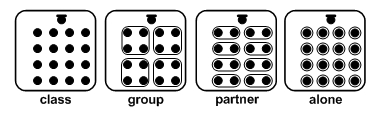
actors2.jpg

But after drawing these icons I reduced the dots to 12:
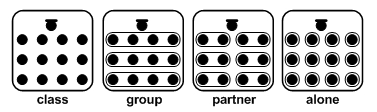
actors3.jpg

As an advantage of these icons you can illustrate what some students are doing in respect of the rest of the class. So if the scenario says "the faster students work alone on additional tasks" you could an icon like this:

actors4.jpg

With 12 dots you can easily illustrate at least the following configurations:

  • whole class
  • half of the class
  • a third of the class
  • a quarter of the class
  • groups of 2
  • groups of 3
  • groups of 4
  • working alone

There are also disadvantages:

  • The more abstract icons are less intuitive and less emotional than my proposition
  • Vincents icons are more difficult to draw on a whiteboard by hand (expecially if you have to draw dozens of them)
  • The icons have to be bigger than mine to be readable:
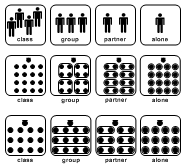
actors5.jpg
, IsInEnglish


Weitere Blogbeiträge aus dem zITBOx Netzwerk

Suchfunktionen im Biblionetz massiv ausgebaut

Suchfunktionen im Biblionetz massiv ausgebaut

Die letzten Tage habe ich mich intensiver mit Claude (Biblionetz:w03768) unterhalten. Entstanden ist dabei eine Erweiterung für das Webinterface des Biblionetzes (Biblionetz:w00778). Für die Objekttypen Begriffe, Personen, Fragen und Aussagen …

Wie soll ich auf problematische wissenschaftliche Publikationen reagieren?

Wie soll ich auf problematische wissenschaftliche Publikationen reagieren?

In unserer Publikation Digitale Lernplattformen in der Volksschule (Biblionetz:b08000) haben Michael Hielscher, Lennart Schalk, Michael Seemann und ich zu generativen Machine-Learning-Systemen geschrieben, dass empirische Studien angesichts der Novität und Dynamik …

Gamification im Unterricht – zwischen Motivation, Design und Lernwirksamkeit

Gamification im Unterricht – zwischen Motivation, Design und Lernwirksamkeit

Spiele im Unterricht haben enormes Potenzial – wenn sie didaktisch sinnvoll eingebettet sind. Entscheidend ist, dass der Lernprozess selbst motivierend gestaltet wird. Gamification kann erste Zugänge schaffen, aber Playful Learning ist nachhaltiger, die den Lernprozess …